

When it comes to Apple’s future, few voices carry as much weight as Ming-Chi Kuo. Known for his rare accuracy and deep understanding of Apple’s supply chain, Kuo doesn’t just predict product launches—he outlines the why behind them.
At AppleX4, we had the chance to ask him directly about what lies ahead. His brief but focused answers reveal more than rumors—they offer a strategic glimpse into Apple’s next era.
Foldable iPhone: Apple’s Most Disruptive Leap Since iPhone X?
Some products change everything. For Apple, that’s happened only a few times—the original iPhone, the iPad, and perhaps most recently, the iPhone X. According to Kuo, the foldable iPhone could have an even bigger impact.

“I think the foldable iPhone will be more significant than the iPhone X, as it can deliver an entirely new large-screen user experience.”
What makes this device different? Kuo points to a seamless, crease-free display, supported by a strong metal hinge and possibly a side-mounted Touch ID sensor. It’s not just about folding—it’s about creating a new category of premium, immersive iPhones.
Apple isn’t rushing this. While other brands compete to be first, Apple wants to be definitive. When it arrives, this foldable could redefine how we carry and use our most personal device.

A18 MacBook: Apple’s Return to the Budget Market—On Its Own Terms
Apple may finally be preparing to meet the education market head-on. For years, the iPad served as the company’s go-to tool for students. But times have changed.
Kuo told us that a MacBook powered by the A18 Pro chip is likely in the works. And its mission is clear:
“The MacBook powered by iPhone chips is expected to offer a lower price point, primarily targeting light users and the education market. Apple previously believed the iPad could adequately serve light users and the education market, but with intensifying competition, they now need a more affordable MacBook to strengthen their competitive position.“
This shift matters. It’s not just about cost—it’s about rethinking what an entry-level Apple laptop can do. Expect better battery life, excellent thermal performance, and the full macOS experience, all in a slim, efficient form.
If this device materializes, it could reshape Apple’s approach to value computing, not just compete with Chromebooks—it might replace them entirely for some users.

Vision Pro and Apple Glass: The Next Paradigm Shift?
Apple’s next leap may not be about screens—it may be about leaving them behind. When we asked Kuo whether Apple is preparing for a world beyond the iPhone, he didn’t hesitate:

“Yes, though it will take at least 3-5 years before we see meaningful results.“
This is more than a product roadmap. It’s a strategic shift toward spatial computing—a future where technology blends naturally into our environment, no longer confined to rectangles in our hands.
And that future is already being built.

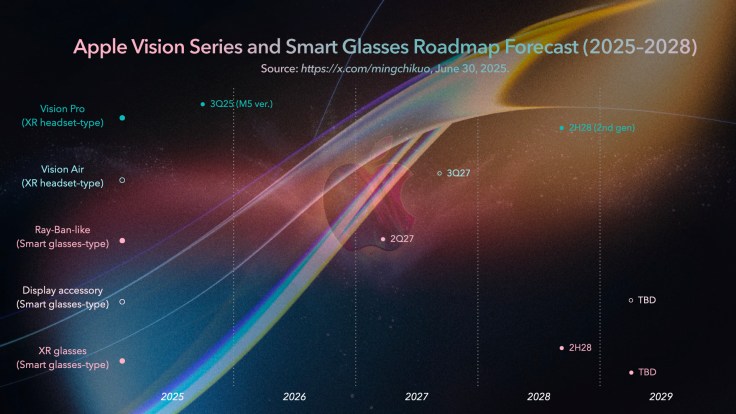
Apple Vision Series & Smart Glasses: A Roadmap into 2028
Kuo gave AppleX4 readers an exclusive preview of Apple’s upcoming wearable ecosystem. These are the key milestones from now through 2028:
- Vision Pro M5 (2025)
Mass production begins in Q3 2025. While most specs remain unchanged, it will feature a new M5 chip. Apple sees this model as a way to maintain XR momentum, reduce component inventory, and support early ecosystem development. - Vision Air (2027)
Arriving in Q3 2027, Vision Air introduces a completely new design—over 40% lighter than Vision Pro. Cost is reduced by using magnesium instead of titanium, switching from glass to plastic, and slimming down sensors. It’ll be powered by the iPhone’s top-tier chip, aimed at broader adoption. - Ray-Ban-Style Smart Glasses (2027)
Slated for Q2 2027, with expected shipments of 3–5 million units in the first year. These glasses won’t have a display but will feature voice and gesture control, AI sensing, audio, video, and camera functions. They could ultimately replace parts of the TWS and smartphone camera market. - XR Glasses with Display (2028)
Mass production is scheduled for late 2028. These will use LCoS waveguide display tech to deliver a color visual experience. A second version with fewer features is also under development. - Display Accessory (On Hold)
Originally planned for 2026, this accessory is currently paused. It was designed to tether to iPhones, using birdbath optics and electrochromic dimming. But its 120–130g weight made it less competitive. Apple is now reconsidering its future.
Kuo’s exclusive comment for AppleX4:
“In my prediction earlier on Apple’s head-mounted roadmap, I referenced the pause of the Display Accessory—a decision made by John Ternus. Going forward, JT is expected to be more deeply involved in new product development, which I believe is a positive move for Apple.”

Final Thoughts
In an industry shaped by noise, it’s rare to encounter voices that offer clarity. Ming-Chi Kuo is one of those voices. His perspective doesn’t just reveal timelines or product specs—it outlines strategy, intent, and the broader vision Apple seems to be quietly building.
What we’ve learned from this exchange goes beyond individual devices. A foldable iPhone poised to redefine portability. A new MacBook direction that signals a shift in how Apple sees entry-level computing. And a long-term play in spatial technology that hints at a world that goes beyond screens.
At AppleX4, our mission has always been to bridge the gap between speculation and substance. With this exclusive, we’re proud to continue elevating the Spanish-speaking tech community in the global conversation—just as we did a few weeks ago with our in-depth dialogue with leaker Majin Bu.
Because in the end, it’s not just about what’s next for Apple. It’s about understanding why it truly matters.


 AppleX4: Tu Fuente Definitiva de Noticias Tecnológicas y el Ecosistema Apple en España